


FAQ
The Ultimate Guide to Softball Field Dimensions 2026
June 20, 2025

Whether you are planning the layout of a brand-new diamond or auditing an existing one, using precise softball field dimensions is non-negotiable for player safety, fairness, and recruiting credibility. This guide addresses the most frequently asked questions about college softball pitching distance, softball base distance, the size of a softball field, and more—ensuring your layout meets all NFHS and NCAA requirements.
Looking for field equipment? Here you go!
Softball Field Dimension Cheat Sheet
Baselines | 60 ft |
Pitching Rubber to Home Plate | 43 ft |
Home Plate to Second Base | 84 ft 10 ¼ in |
Backstop from Home Plate | 25-30 ft |
Outfield Fence from Home Plate | About 220 ft |
Batters Box | 3 ft W x 7 ft L |
Home Plate to Backstop | 25-30 ft Gap |
Outfield Warning Track | At least 10 ft wide |
Pitchers Circle | 8-foot radius, 16-foot diameter |
Softball Base Distances
Distance from Softball Pitching Rubber to Home Plate
College: 43 feet
High school: 43 feet
Youth: 35 - 40 feet (League dependent)
Softball pitching distance also drives batting cage length. A 55-foot cage covers the 43-foot regulation distance with room to spare. For complete sizing guidance, see our batting cage sizing for softball recommendations.
To correctly measure, take the distance from the front edge of the 24-inch rubber straight to the plate’s rear point. A two-inch error can shave roughly 0.01 seconds off a batter’s reaction time, so field crews recheck this line often.
Size of a Softball Pitcher’s Circle
College: 8 ft radius, 16 ft diameter, 24 in x 6 in pitching rubber
High school: 8 ft radius, 16 ft diameter, 24 in x 6 in pitching rubber
Youth: 8 ft radius, 16 ft diameter, 24 in x 6 in pitching rubber
The pitching circle and pitching rubber are always the same size, regardless of the level of play. Lining the circle helps umpires enforce pitching rules and keeps field crews consistent when they re-mark the diamond after rain or heavy play.
Official Softball Field Distance Between Bases
Measure each side of the 60-ft square in this order to confirm your baselines are accurate:
Home Plate → First Base | Back tip of home plate to the back white corner of first base |
First Base → Second Base | Back white corner of first base to the center of second base |
Second Base → Third Base | Center of second base to the back white corner of third base |
Third Base → Home Plate | Back white corner of third base to the back tip of home plate |
Following this pattern keeps every baseline uniform and meets NFHS and NCAA rules. Youth leagues may shorten the 60-ft distance, so coaches should confirm their local rule book before chalking the diamond.

Distance from Home Plate to Second Base on a Softball Field
College: 84 feet 10¼ inches
High school: 84 feet 10¼ inches
Youth: 84 feet 10¼ inches
This figure mirrors the distance from first to third because the four 60-foot baselines form a perfect square. Double-checking this diagonal is a quick way to confirm that your 60-foot softball bases distance and the rest of the core softball field dimensions are accurate before play begins.
Space from Home Plate and the Backstop on a Softball Field
College: 25-30 feet
High school: 25-30 feet
Youth: 25-30 feet
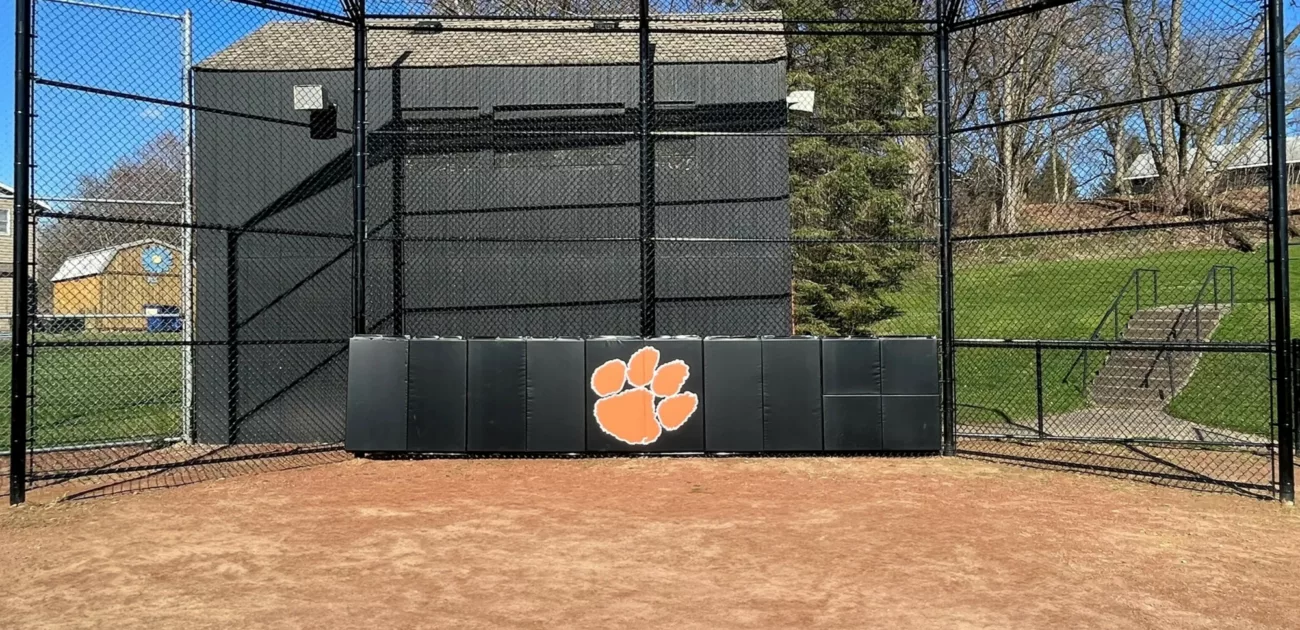
This range gives catchers enough room to track foul pop-ups without risking collisions. The backstop should be vertical and extend slightly over the field to stop high fouls. If it’s built from hard materials such as wood, concrete, or brick, add backstop padding to cut ricochet risk and protect players. Backstop padding is just one piece of a complete field safety layout. Our field padding guide for softball covers outfield wall padding, fence rail pads, dugout padding, and fence top protection for every surface on the diamond.
Official Softball Field Fence Heights & Depths
Softball Fence Height | Softball Foul Line Distance | Softball Centerfield Distance |
6 ft | 190 ft | 220 ft |
4 ft | 210 ft | 230 ft |
According to NCAA softball fence guidelines, no point on the fence may sit closer than 190 ft or farther than 235 ft. The table above shows how fence height affects minimum distance — a taller 6 ft fence can sit closer to home plate (190 ft at the foul lines) because it's harder to clear, while a shorter 4 ft fence must be pushed back to 210 ft to keep home run rates balanced. Programs often shape the outfield arc so the power alleys land a few feet deeper than the foul lines, but the entire wall must stay inside the 190–235 ft window. Portable outfield walls make it easy to adjust depth for tournaments or to share the space with other sports.
How to Lay Out a New Softball Diamond
1. Position home plate
Tie a string to one corner post, swing it past where the pitching rubber will sit, and mark the arc.
Repeat from the other corner.
Draw a straight line through the point where the two arcs intersect.
Mark a point 25 ft from the backstop on that line and set the back tip of home plate there.
2. Mark second base
Stretch a string from the midpoint of the backstop through home plate’s tip and over the infield.
Measure 84 ft 10 ¼ in—the diagonal in a 60-ft square—and mark the center of second base.
3. Mark first and third
From home, swing a 60 ft arc toward first.
From second, swing another 60 ft arc toward first; their intersection marks the back-right corner of first base.
Repeat on the third-base side for third.
This confirms the official softball base distance (also searched as distance between bases in softball and softball bases distance).
4. Set the pitching rubber
Stay on the home-to-second line.
Measure 43 ft from home’s tip; that point is the front edge of the rubber.
Check that both front corners are the same distance from the matching front corners of home plate.
The 43-ft mark matches college softball pitching distance and high school softball pitching distance queries.
5. Finish lines and extras
Chalk the 3 × 7 ft batter’s boxes 6 in from the plate, draw foul lines, and place foul poles.
Follow NCAA or NFHS specs for arc depth and any turf cuts.
Softball Field Maintenance Checklist
Infield covers — Shield skinned dirt and chalk lines from rain.
Backstop netting — Block foul tips and line drives without obstructing spectator view.
Pitching circle covers — Keep the mound and plate playable after a storm.
Portable fencing — Modular panels for quick outfield setup and removal.
Fence-top and rail padding — Add player protection and a clean finish.
Softball outfield windscreen — Cut wind, display graphics, and limit visual distractions.
Softball Field Dimension FAQs
How do softball field dimensions differ from baseball field dimensions?
- Pitch delivery: Softball pitchers throw underhand with a windmill motion from a flat rubber 43 ft from home plate (women's fast-pitch). Baseball pitchers throw overhand or side-arm from a raised mound 60 ft 6 in away.
- Ball size: A regulation softball measures 11–12 inches around and weighs about 6½–7 oz — larger and a bit heavier than the 9-inch, 5-oz baseball.
- Field dimensions: Softball uses 60-ft baselines and fences roughly 190–235 ft from home. Baseball diamonds stretch 90 ft between bases, and outfield walls often sit 300–400 ft away. The shorter layout keeps play fast and rewards quick reactions, while the larger ball is easier to see and grip.
What is the distance from the softball pitching rubber to home plate?
The pitching rubber sits 43 ft from the back tip of home plate at both the college and high school levels. Youth leagues typically shorten this distance to 35–40 ft depending on age group and league rules. Always measure from the front edge of the rubber straight back to the plate's rear point — even a two-inch error can noticeably affect batter reaction time.
What are the dimensions of a softball batter's box?
Each batter's box is a rectangle 3 ft wide by 7 ft long, with the outside edge positioned 6 inches from the plate. The front line sits 4 ft ahead of a line drawn through the center of the plate. These dimensions are consistent across NCAA, NFHS, and most youth leagues, though field crews should re-chalk the boxes between innings to keep hitters positioned correctly relative to the strike zone.
How big should the warning track be on a softball field?
The warning track must be at least 10 ft wide around the outfield fence. Most programs use crushed stone, dirt, or specialized rubber to create a surface that feels noticeably different underfoot from the outfield grass or turf.
Why is there a warning track on a softball field?
The warning track alerts outfielders that they are approaching the wall, giving them a chance to adjust their speed and body position before contact. Because softball outfield fences are significantly closer than baseball fences — as close as 190 ft — wall collisions happen more frequently, making the warning track an essential safety feature.
What material is used to create the warning track on a softball field?
The track is typically a coarse, well-draining mix laid 3 inches deep, made of crushed stone, compacted dirt, or specialized rubber granules. The key is that the texture must feel distinctly different from the playing surface so fielders can identify the transition without looking down.
How far apart are the bases on a softball field?
The distance between adjacent bases is 60 ft at the college, high school, and most youth levels. This is measured from the back tip of home plate to the back corner of first base, then corner to center to corner around the rest of the diamond — the same measuring pattern used on baseball fields, just at a shorter distance.
How far is second base from home plate in softball?
The diagonal from home plate to the center of second base is 84 ft 10¼ in at the college and high school levels — the natural result of a perfect 60-ft square. This measurement doubles as a quick accuracy check: if the home-to-second diagonal doesn't match 84 ft 10¼ in, one or more of your baselines is off.
CoverSports
5000 Paschall Avenue
Philadelphia, PA 19143, USA

